Die-Cut and Uniquely Shaped Business Cards
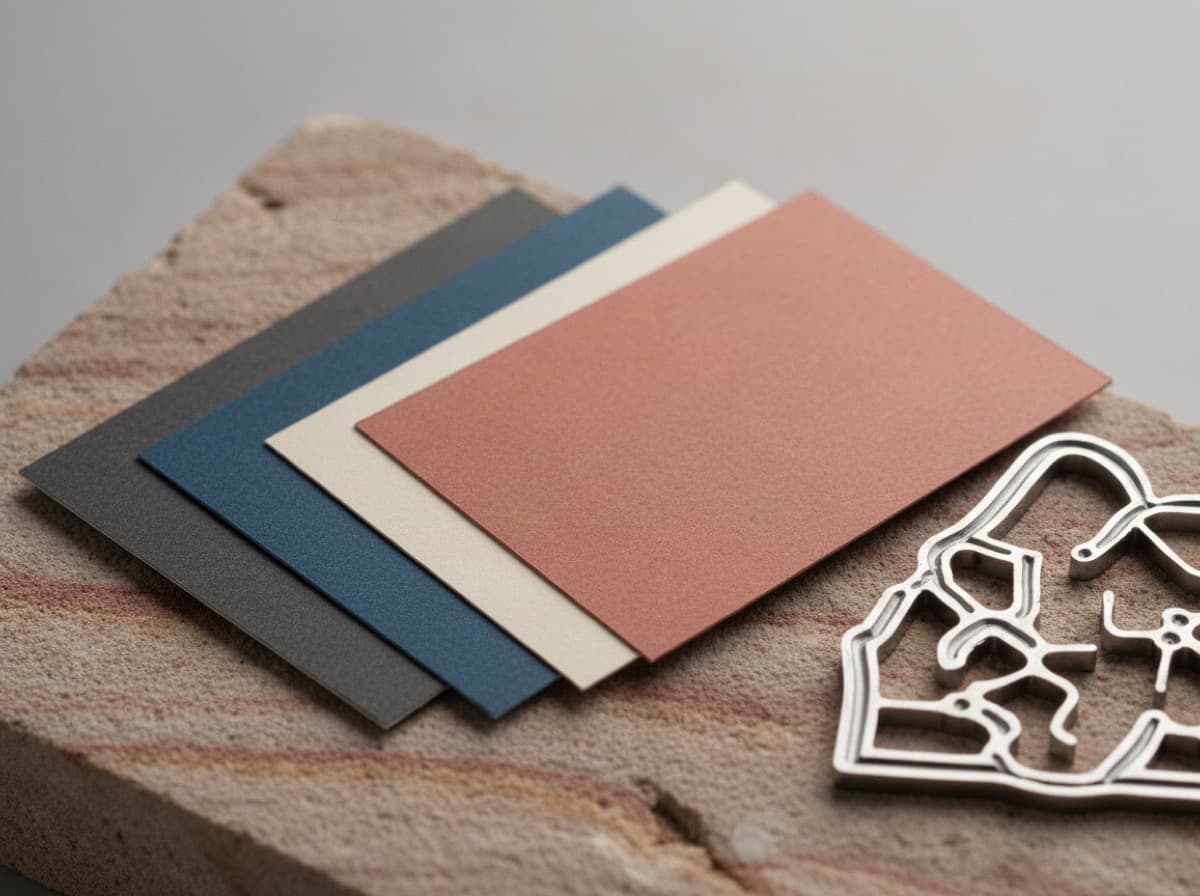
Die-cut business cards go beyond the standard rectangle to take a custom shape — a circle, a square, a rounded-corner rectangle, a silhouette, or something entirely unique — through a cutting process that uses a shaped steel blade (the "die") to press through the printed sheet. For most professionals, a rectangular card with an excellent design and premium finish accomplishes more than a custom shape. But for certain brands — a coffee roaster whose card is shaped like a coffee bag tag, an architect whose card echoes a structural form, a hair studio whose card has notched corners that become a comb — the shape is a brand statement that a rectangle can't make. This guide explains how die-cutting works, what shapes are practical, and what trade-offs the technique brings.
How die-cutting works
After a sheet of cards is printed and, if specified, laminated, it's fed through a die-cutting press. The die — a custom steel rule bent into the desired shape and embedded in a board — is pressed through the sheet, cutting the card to the specified outline. Custom dies are made for each unique shape; standard shapes (circles, squares, rounded corners) use in-house dies that most printers keep on hand.
Because a custom die is required for truly unique shapes, there's a setup fee: the die itself costs more than a standard cut. Standard alternative shapes — circles, squares, and rounded corners on a standard rectangle — use existing dies and add little or no setup cost.
Standard die-cut options
Most business card printers offer these without custom die charges:
Rounded corners — the most widely used die-cut variation. The card stays rectangular but corners are cut to a radius (typically 1/8 inch). Rounded corners soften the card's feel and are extremely common in premium design; they're practical, fit standard cardholders, and add a design detail without complexity.
Square cards — equal-dimension cards (typically 2 × 2 inches) are distinctive in a landscape card pile, fit many cardholders (or can stand upright), and suit minimal, brand-identity-forward designs.
Circle cards — round cards are memorable and unusual; they don't fit standard cardholders, which is a practical trade-off to acknowledge. They work best for brands where the circle is a meaningful design choice (a photographer's aperture, a record label, a yoga studio).
Slim cards — a narrower-than-standard rectangle (3.5 × 1.5 inches or similar). Visually distinctive, fits inside a wallet slot, and gives a different layout proportion.
Custom die-cut shapes
For a truly brand-specific shape — a wine bottle, a key, a house silhouette, a dog bone, a leaf — a custom die is made to your specification. The design considerations:
The shape must be printable and functional. Extremely thin protrusions snap off during handling; sharp corners become dog-eared almost immediately. Shapes with thin extensions (a star with thin points, a human silhouette with thin limbs) need a minimum "neck" width to stay intact.
Content placement changes completely. A non-rectangular shape has no straight-edge margins in the conventional sense; text and logos must be positioned within the irregularly-shaped safe area, avoiding proximity to the cut edge. File setup is more complex than a standard rectangle.
Quantities matter more. Custom die setup cost is spread across the run — the per-card premium decreases with quantity. For very small runs, custom die shapes carry a high per-card cost. Standard shapes (circles, squares) skip this problem.
Practical trade-offs
| Feature | Standard rectangle | Rounded corners | Circle/Square | Custom shape | |---|---|---|---|---| | Cardholder fit | Perfect | Good | Varies | Usually no | | Die setup cost | None | None | None/Low | Yes | | Content area | Full | Nearly full | Smaller | Variable | | Memorability | Standard | Slightly elevated | High | Highest | | Durability | Excellent | Excellent | Good | Good (if designed well) |
The memorability/practicality trade-off is the core tension. A custom-shaped card is immediately distinct but doesn't fit in wallets, cardholders, or filing systems designed for standard rectangles. For someone who hands out cards at a specific event context — an art fair, a boutique market, a hospitality setting — the trade-off is worth it. For everyday professional networking, a rounded-corner or squared card on a premium stock accomplishes nearly as much.
Design rules for die-cut cards
Bleed extends to the die-cut line. Any background color or image that runs to the cut edge must extend at least 3mm beyond the die-cut line. The cut is not perfectly precise, and without bleed, the card shows a white rim around the shape.
Safe zone moves inward. Text and logos must be kept at least 3mm inside the die-cut edge. Shapes with curves require particular care: content placed close to a curved cut line will look clipped and disproportionate.
Design for the shape, not against it. A circle card with a layout designed for a rectangle looks wrong. Redesign the hierarchy for the new proportion — circular layouts often center everything and use concentric alignment; they resist the left-to-right reading pattern of rectangular cards.
For how to work with premium finishes on die-cut cards, see our premium finishes overview.
Bottom line
Rounded corners are the practical sweet spot: they add a subtle design refinement without any practical trade-off and suit almost any professional context. Circles and squares are good choices when shape distinctiveness is a brand value and the recipient base accepts non-standard cards. Custom die-cut shapes are for brands where the form is integral to the identity — powerful when executed well, indulgent when it's shape for its own sake.
Frequently Asked Questions
What is a die-cut business card?
A die-cut business card is cut to a shape other than a standard rectangle using a shaped steel cutting blade (the die) pressed through the printed sheet. Common options include rounded corners, circles, and squares; custom shapes require a bespoke die.
Do die-cut business cards cost more?
Standard alternative shapes (rounded corners, circles, squares) add little or no extra cost because printers keep these dies on hand. Custom shapes require a die fabrication fee that is spread across the print run — less expensive per card at higher quantities.
Do circle or square business cards fit in cardholders?
Circle cards do not fit most standard cardholders. Squares may fit depending on holder design. Rounded-corner rectangles fit perfectly. If cardholder compatibility matters, choose rounded corners or a standard rectangle.
What is the most popular die-cut option?
Rounded corners are by far the most common die-cut variation — they add a polished, modern quality without changing the card's basic functionality or fit. They're widely available at most professional printers and add no meaningful cost.
How do I design for a die-cut business card shape?
Extend all background colors and edge-running images at least 3mm beyond the die-cut line (bleed). Keep all text and logos at least 3mm inside the cut line (safe zone). Redesign the layout specifically for the shape's proportions — circular cards need centrally-oriented layouts; rectangular cards adapted for circles look wrong.
What custom die-cut shapes work well for business cards?
Shapes with no thin protrusions or sharp-pointed extremities work best — rounded forms, bold silhouettes, simple tags, and ovals. Thin protrusions (star points, thin limbs) break off with handling. Discuss the design with your printer before committing to ensure the shape can be die-cut cleanly.
Get 10% off your first order
Join our list for practical printing guides, new finish ideas, and a welcome coupon for your first order.
No spam. Unsubscribe anytime.