Edge-Painted Business Cards: A Complete Guide
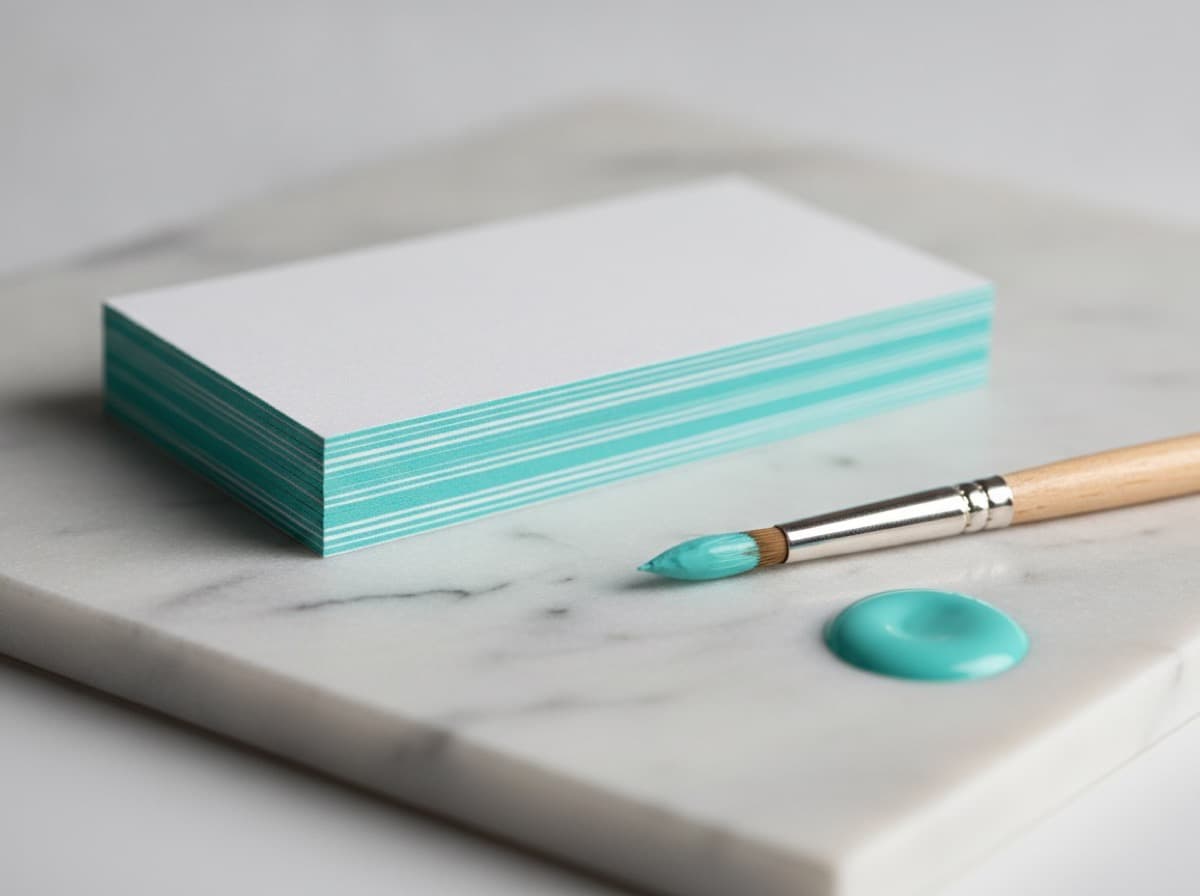
Edge-painted business cards have a solid band of color applied to all four sides of the card's cross-section, turning the edge — the part that's normally plain white — into a deliberate design element. The effect is barely visible when the card is face-up on a table, but the instant someone picks it up and looks at the side, a stripe of vivid color appears. It's a detail that rewards attention, and for that reason it's become one of the most memorable premium finishes in the business card category. This guide explains how edge painting works, what colors are available, which stocks it requires, and how to combine it with other finishes.
How edge painting works
Edge painting is applied after the cards are cut to size. A finished stack of cards is clamped tightly (so the edges are flush and form a flat, unified surface), and an ink or paint is applied to the exposed edge by brush, roller, or spray. The clamping is critical: any misalignment shows as a ragged line rather than a clean stripe. After the color is applied, the stack is allowed to dry before unclamping and packaging.
Because the edge is painted after cutting, it cannot run off the edge or bleed like a printed element — the color sits on top of the paper cross-section. On a single-sheet card the edge is typically white paper or the substrate color; on a duplexed card, a colored core may be visible between the two face sheets before the paint goes on, adding an extra layer of detail.
What cards are suitable for edge painting?
Edge painting requires cards thick enough to have a visible, paintable edge:
- Minimum 16pt laminated — a 16pt card has an edge, but it's narrow; the painted stripe is thin and the technique works best with a well-applied color and precise clamping.
- 18pt and above — more surface area for the paint, a more visible stripe.
- 32pt duplexed cotton — the ideal base. The thick edge shows the full color treatment, and the duplexed construction creates a core that can be a different color from the face sheets (creating a "sandwich" effect).
The stock surface matters too. Edge painting works on laminated cards (matte, soft-touch, or gloss) and on uncoated stocks; both accept paint adhesion reliably. Cards with a coated face lamination benefit from the contrast between the matte or soft surface and the painted edge color.
Our thickness guide explains the duplexed construction that makes edge painting most effective.
Available colors and metallic edges
Edge painting can be done in:
- Flat colors — a solid, opaque coat of any color. Classic choices are black (very striking against a white or cream face), white (subtle but clean on a dark card), and brand colors.
- Metallic paints — gold, silver, rose gold, and copper. Metallic edge painting is somewhat more expensive than flat color but produces an effect that approaches foil stamping on the edge.
- Neon and fluorescent — bold, high-visibility colors that catch the eye immediately.
- Multi-color — some studios apply two or more colors on different edges, or use gradient techniques; cost and complexity are higher.
The number of available colors varies by printer. Most offer a curated palette; custom color matching (Pantone) is possible but adds cost and may require a minimum order size.
Edge painting vs edge foiling
Edge foiling applies a metallic foil rather than paint to the card edges. The result is a more consistently metallic, mirror-like finish than metallic paint — because the foil film is applied hot under pressure, its reflectivity is higher than any painted metallic alternative. Edge foiling typically costs more and is less widely available than edge painting, but for a card that specifically needs high-gloss metallic edges, it's the stronger technique.
Combining edge painting with other finishes
Edge painting works best as part of a layered premium card:
- Letterpress face + painted edge — the debossed impression on the face and the color stripe on the edge are the two premium signals, one tactile and one visual. Together on a 32pt cotton-duplexed card, this combination consistently produces the most memorable card in a pile.
- Foil face + painted matching edge — a gold or rose-gold foil-stamped logo on the face with a matching gold painted edge extends the metallic theme to three dimensions.
- Matte laminate + black edge — clean, modern, and striking. The soft matte face contrasts with a razor-thin line of black on the side.
See our premium finishes guide for more combinations and how to stack finishes without over-designing.
Practical notes: what can go wrong
Edge painting requires tight tolerances. A few things cause poor results:
- Misaligned cards during clamping — if cards are not perfectly flush, the paint bleeds slightly to the face side of some cards. Well-run print shops re-clamp multiple times; ask about the process before ordering.
- Thin stock — on 14pt unlaminated stock, the edge is too thin for a clean application; the color goes on unevenly.
- Inadequate drying time — if cards are unclamped before the paint is dry, they can stick together or the color can smear. Rush production can cause this.
- Porous or uncoated stock with incompatible ink — on some uncoated stocks, the paint absorbs unevenly. Request a sample or specify a stock the printer knows works with their edge-painting process.
Bottom line
Edge-painted business cards turn the unseen edge into a signature detail that reveals itself the moment someone holds the card. The technique requires a thick base (32pt duplexed is ideal), is available in flat and metallic colors, and pairs naturally with letterpress or foil-stamped faces. Request a sample before committing to a large run, and confirm the printer's clamping and drying process — quality in this finish is almost entirely a function of production care.
Frequently Asked Questions
What is an edge-painted business card?
An edge-painted business card has a solid band of color applied to all four sides of the card's cross-section — the narrow edge between the front and back. The effect is hidden when the card lies flat but visible immediately when held, creating a signature detail.
What thickness do I need for edge-painted cards?
At least 16pt laminated, though the technique looks best on 18pt and above. The ideal base is 32pt duplexed stock — the thick edge gives the paint a substantial surface area and may also show a contrasting core color between the face layers.
How does edge painting differ from edge foiling?
Edge painting uses liquid ink or paint applied by brush or roller. Edge foiling applies a hot-pressed metallic foil film. Foiling produces a higher-gloss, more mirror-like metallic finish; painting is more widely available and less expensive, with good metallic paint options for gold and silver.
What colors are available for edge painting?
Most printers offer a standard palette of flat colors (black, white, and brand colors are most common) plus metallic options (gold, silver, copper, rose gold). Neon and fluorescent are also widely available. Custom Pantone matching is possible but usually requires minimum quantities and adds cost.
Can edge painting be combined with foil or letterpress?
Yes — this is among the most effective combinations. A letterpress-debossed face on 32pt cotton stock with a painted edge is a widely admired premium card formula. Matching a foil color on the face to a metallic paint on the edge extends the theme to three dimensions.
Can edge painting chip or peel?
With quality paint and proper application, edge painting is durable for normal use. Excessive wallet or pocket friction can eventually show wear on very thin edges, which is another reason thick stock (32pt) is preferable — the wider painted surface is more resistant to wear than a thin stripe on a 14pt card.
Get 10% off your first order
Join our list for practical printing guides, new finish ideas, and a welcome coupon for your first order.
No spam. Unsubscribe anytime.
Ready to start your print order?
Browse Printing ProductsNot sure which option fits? Ask Pro Card Crafters