Business Card Thickness Explained: GSM, PT, and Why It Matters
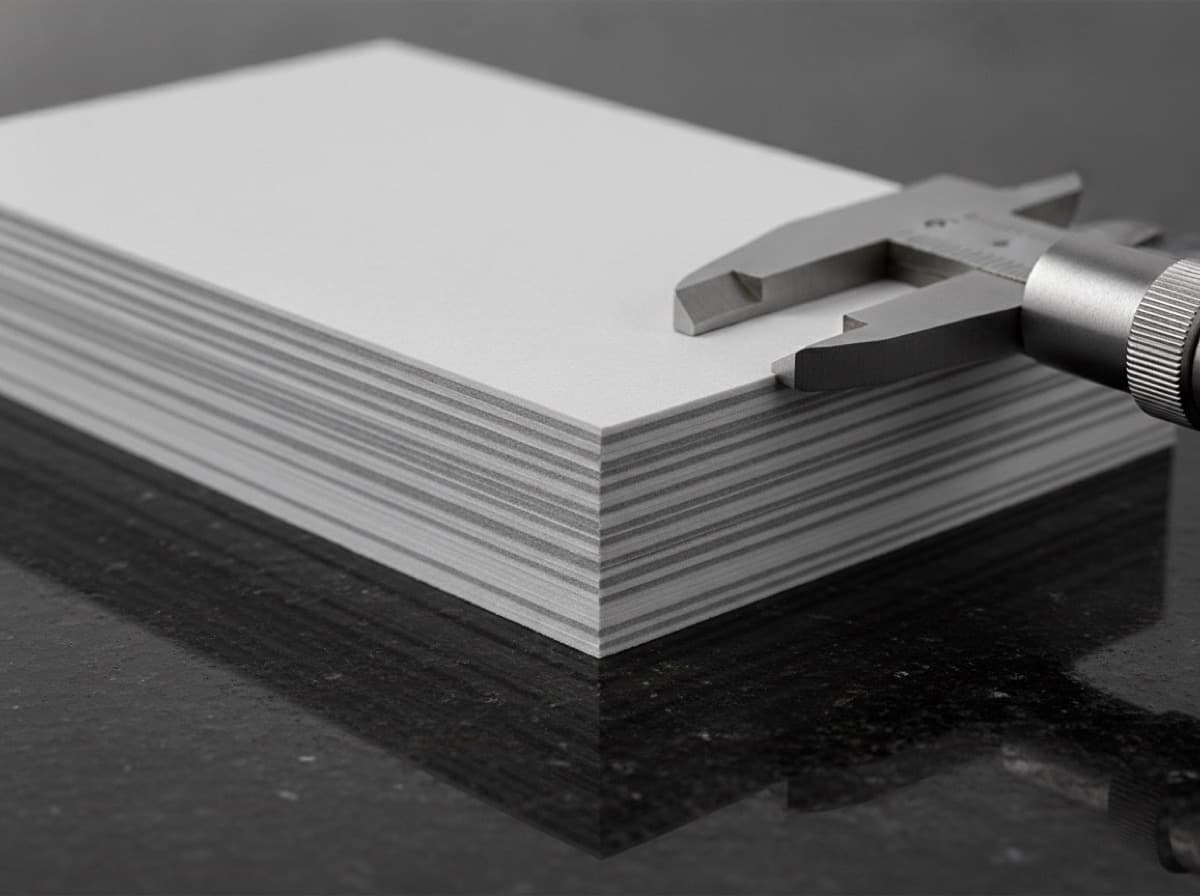
Business card thickness is measured in two systems that often confuse buyers: GSM (grams per square meter, a weight measure) and PT or points (a direct thickness measure in thousandths of an inch). A heavier card signals quality and resists bending; a thinner card costs less and fits better in some cardholders. Understanding what these numbers mean in practice — and how stock, coating, and lamination all affect the final feel — lets you spec a card that does exactly what you need without paying for weight you don't. This guide explains both systems, typical ranges, and how to pick the right thickness for your card.
GSM vs PT: what each measures
GSM (grams per square meter) is a paper weight measure. It describes the mass of a one-square-meter sheet — the higher the number, the denser and usually thicker the paper. Standard office paper is around 80gsm; premium uncoated business card stock starts around 300gsm; heavyweight cotton stock runs 600gsm or more when duplexed.
PT (point or point thickness) measures actual physical thickness: 1pt = 0.001 inches. A 16pt card is 0.016 inches thick. This is the measure US printers most commonly use because it directly describes what customers feel.
The two numbers correlate but don't convert to a simple formula — a coated paper and an uncoated paper of the same weight will have different thicknesses because the clay coating and the fiber structure affect density differently. When comparing across suppliers, always look at both numbers if possible.
Common business card thicknesses
| Thickness | Approx. GSM | Feel | Best for | |---|---|---|---| | 14pt | ~300–350gsm | Standard, slightly flexible | Economy volume cards | | 16pt | ~350–400gsm | Solid, business-appropriate | Most professional cards | | 18pt | ~400–450gsm | Notably substantial | Premium, laminated cards | | 32pt | ~600–700gsm | Very thick, board-like | Luxury, cotton, letterpress | | 38pt+ | 700gsm+ | Extremely heavy | Statement cards, duplexed |
14pt is the entry level for professional cards — it's what you'd receive from a standard online printer at budget pricing. 16pt is the sweet spot for most professional use: it feels solid and doesn't bend easily in a wallet. 18pt and above signals deliberate premium intent. 32pt cotton-duplex stock — the standard for letterpress printing — feels closer to a thin piece of board than conventional paper.
How lamination affects perceived thickness
The base stock weight is only part of the story. Lamination — a layer of film applied after printing — adds both thickness and stiffness and changes the feel dramatically.
- Matte lamination on a 16pt base produces a card that feels thicker than an 18pt uncoated card, because the laminate adds rigidity that amplifies the sense of substance.
- Soft-touch lamination (suede-like) adds a similar amount of physical thickness with a very different surface feel — described in our soft-touch guide.
- Gloss lamination adds less perceived thickness than matte but increases surface hardness and sheen.
- No lamination — uncoated or aqueous coated — gives the truest read of the stock weight and is the base of choice for letterpress and tactile techniques.
Duplexing: how extra-thick cards are made
Duplexed cards are made by bonding two card sheets face-to-face, typically with a colored or patterned paper core between them ("center core" or "painted edge" ready). The result is a card that's roughly twice as thick as a single sheet — typically reaching 32pt or more — with clean, even edges. Duplexing is how premium print studios achieve the extreme thickness of luxury cards without relying on an enormous single sheet that would be structurally impractical.
The core can be left plain (white or natural) or dyed a color, which then shows on the card's edges. Edge-painted cards take this further by applying a painted or foiled edge color on top.
Does thickness actually matter?
In practice, yes — in two specific ways:
First impression. A heavier card lands differently in the hand. That tactile signal happens before the recipient reads a word, and it correlates with the perceived quality of whoever gave the card. Research on consumer perception consistently finds that heavier objects feel more valuable.
Durability. Thinner cards bend and crease in wallets; thicker cards resist that. If the card will live in a back pocket or a loose stack, 16pt or above significantly extends how long it looks presentable.
Beyond a certain point — around 32pt — the difference in durability is marginal. An extremely thick card won't fit in standard cardholders and can feel theatrical rather than premium. Match the weight to the context: a 32pt card for a luxury brand at select events; a 16pt card for everyday professional networking.
Bottom line
For most professional cards, 16pt is the right starting point: solid, affordable, and appropriate for the full range of lamination and finish options. Step up to 18pt or 32pt (duplexed cotton) when the card is a deliberate statement piece or when it will pair with letterpress or edge painting. Don't let weight alone dictate the decision — a 16pt card with foil stamping or a carefully designed layout beats a thick card with nothing interesting on it.
Frequently Asked Questions
What does 16pt mean on a business card?
16pt means the card is 0.016 inches thick — 16 thousandths of an inch. It's among the most common professional card weights: solid enough to feel substantial, light enough to fit standard cardholders without forcing.
What is a good GSM for business cards?
For standard professional cards, 350–400gsm (roughly 16pt) is a reliable range. Premium and luxury cards often run 600gsm or higher (32pt duplexed), while budget cards may be 300gsm (14pt). GSM and thickness correlate but don't convert directly, because coating and fiber type affect density.
Is a thicker business card always better?
Not always. Thickness beyond about 32pt can make cards too stiff for standard cardholders and feel excessive rather than premium. The right weight depends on the card's purpose: everyday networking at 16pt; a deliberate luxury exchange at 32pt+.
What is a duplexed business card?
A duplexed card is made by bonding two sheets of paper face-to-face. The bonded card is roughly twice as thick as a single sheet, typically reaching 32pt or more, and may have a colored or white core visible at the edges. Duplexing is how very thick premium cards are produced.
How does lamination affect business card thickness?
Lamination adds a thin film layer that increases both physical thickness and perceived rigidity. A 16pt card with matte lamination can feel thicker and more substantial than an 18pt uncoated card because the film stiffens the base stock.
What thickness is used for letterpress business cards?
Letterpress printing is done on thick, soft, usually cotton stock — typically 32pt or more, often duplexed. The cotton fiber needs enough body to accept the die impression cleanly without cracking or showing through the reverse side.
Get 10% off your first order
Join our list for practical printing guides, new finish ideas, and a welcome coupon for your first order.
No spam. Unsubscribe anytime.
Ready to send your file to print?
Order Business CardsNot sure which option fits? Ask Pro Card Crafters