Business Card Paper Stock Guide: 14pt, 16pt, and 32pt Thickness Explained
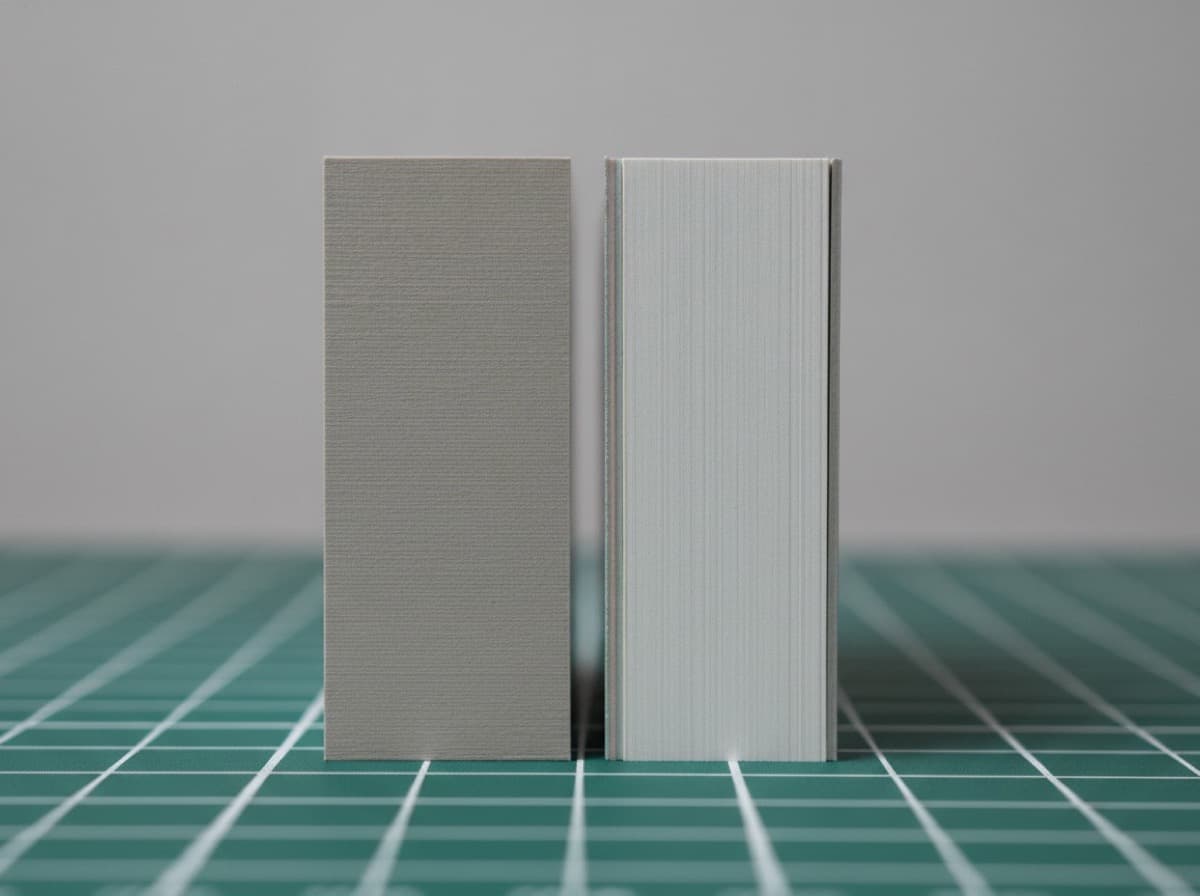
When you order business cards, one of the specifications you'll choose is the paper stock — the material and thickness of the card itself. Paper stock directly affects how your card feels in someone's hand, how durable it is, how well it holds up over time, and what printing finishes can be applied. Most people order the default without thinking about it, but understanding paper stock differences helps you make a better decision for your brand.
What Does "pt" Mean?
"pt" stands for point — a unit of thickness measurement. 1 point = 1/1000 of an inch (0.001"). So:
- 14pt = 0.014 inches (0.355mm)
- 16pt = 0.016 inches (0.406mm)
- 18pt = 0.018 inches (0.457mm)
- 32pt = 0.032 inches (0.812mm) — about twice as thick as a credit card
This is NOT the same as paper "weight" (like 80 lb, 100 lb, 120 lb text, etc.) — "pt" is a direct thickness measurement, while paper weight is based on how much a ream of the paper weighs.
Standard Business Card Stocks
14pt Card Stock
14pt is the industry standard for business cards and what most online card printers mean when they say "standard" stock. A large portion of the business cards you encounter in professional settings are 14pt.
Characteristics:
- Solid, professional feel — not flimsy, not luxury
- Can support single or double-sided printing easily
- Compatible with virtually all finishes: gloss, matte, UV, laminate
- Most cost-effective option
- Slight flexibility — will bend slightly under pressure but won't crumple
Who it's for:
- Budget-conscious professionals who want a professional card without premium cost
- High-volume networking (conferences, trade shows) where you'll give out many cards
- Functional business cards where the information is the priority
- Cards that will be filed or scanned (slightly thinner fits card holders and scanners better)
16pt Card Stock
16pt is the most popular "premium" option — thicker than standard but not dramatically so. Many professional printing companies offer 16pt as their "premium" or "upgraded" standard.
Characteristics:
- Noticeably stiffer and heavier than 14pt
- Significantly better tactile impression — feels more substantial in hand
- Demonstrates quality and investment in professional materials
- Still compatible with most finishes
- Works well for single and double-sided printing
- Standard credit card is approximately 10pt; 16pt is substantially heavier
Who it's for:
- Most professionals who want a solid, quality card without luxury pricing
- Client-facing professionals where first impressions matter (consultants, advisors, real estate)
- Professionals giving cards to senior executives or luxury-market clients
- The sweet spot between cost and quality for most use cases
ProCardCrafters recommendation: 16pt is the right choice for most professionals — it's substantially better than 14pt and costs only marginally more.
18pt Card Stock
18pt occupies the space between standard premium and luxury stock. Not all printers offer 18pt specifically — some jump from 16pt to 32pt. Where available, 18pt offers:
Characteristics:
- Premium feel — clearly heavier than 16pt
- Very slight additional stiffness
- May be marketed as "extra heavy" or "heavy" stock
- Works with most finishes
Who it's for:
- Professionals who want premium without the dramatic cost jump to 32pt
- Luxury or high-end service businesses
32pt Card Stock (Ultra-Thick / Luxury)
32pt is approximately twice the thickness of a credit card and creates a genuinely different physical experience from standard cards. Holding a 32pt card for the first time is noticeably different — it feels almost board-like.
Characteristics:
- Exceptionally thick and rigid — virtually no flex
- Luxury tactile impression — premium brand signal
- Often used with specific finishes that work well with the thickness (soft-touch, matte, letterpress)
- Can be edge-painted (colored edges on the thick side of the card — very distinctive)
- More expensive — typically 2–4× the cost of 16pt
- Heavier to ship (for large quantities)
- May not fit in some standard card holders (designed for 14–16pt)
Special options at 32pt:
- Edge painting: The thick edge of a 32pt card can be painted (gold, silver, colored), creating a striking look when the card is fanned. This requires 32pt minimum because thinner cards don't have enough edge to hold paint.
- Layered / duplex / triplex: Some 32pt cards are made by laminating two or three thinner cards together, which allows for different colored paper layers (black core, white core, colored layer) visible at the edge.
Who it's for:
- Luxury brands, high-end service professionals (private wealth management, luxury real estate, fashion brands)
- Creative professionals for whom the card is a design statement
- Anyone who wants to make a distinctly memorable physical impression
- Industry contexts where premium cards are expected (private equity, luxury hospitality, fashion, celebrity clients)
Special Stocks: Kraft, Colored, Uncoated, Cotton
Kraft/natural card stock: Brown or natural-toned paper; earthy, organic aesthetic; popular with eco-conscious brands, organic food businesses, craft/artisanal brands. Typically 14–16pt equivalent.
Colored stock: Colored paper (not just colored printing on white paper) — the paper itself is red, blue, black, etc. Creates different aesthetic when the card edge is visible or when printing on both sides.
Uncoated / natural finish: Paper without any coating — slightly toothy, absorbent texture; very different feel from coated stock. Ink soaks into the paper rather than sitting on top. Appropriate for letterpress printing, stamps, and designs where texture is part of the aesthetic.
Cotton / 100% cotton card: Cotton fiber paper (Crane & Co., etc.) — extremely luxurious and distinctive tactile experience; very expensive; used for high-end stationery, formal business correspondence, very premium card contexts. Often used with letterpress or engraving.
Plastic / PVC cards: Not paper at all — clear or white plastic, similar to a credit card. Very distinctive, waterproof, doesn't crumple. Appropriate for spa, pool, beach businesses, or any context where waterproof cards are practical. Requires special printing (digital printing on PVC).
Metal cards: Stainless steel, aluminum, or brass business cards. Extremely premium and memorable. Heavy (real metal weight). Very expensive. Can be laser-engraved or etched. For very high-end or tech-forward professionals. Not printable via standard offset — requires laser or chemical etching.
Paper Stock vs. Finish
Paper stock (thickness) and finish (surface treatment) are separate choices:
| Stock | Can Have These Finishes | |-------|------------------------| | 14pt | Gloss UV, matte laminate, soft-touch | | 16pt | Gloss UV, matte laminate, soft-touch, spot UV | | 32pt | Matte laminate, soft-touch, edge painting, letterpress, foil |
For letterpress, foil stamping, and edge painting, 32pt (or at minimum 18pt) is typically required — thinner stocks can warp under the pressure of letterpress dies.
Choosing Your Stock
| Goal | Recommended Stock | |------|-------------------| | Budget professional | 14pt | | Standard premium | 16pt (most common) | | Luxury impression | 32pt | | Edge painting | 32pt (required) | | Letterpress | 32pt or thick uncoated | | Eco/organic brand | Kraft or uncoated | | Waterproof | Plastic/PVC | | Ultra-premium / memorable | 32pt with soft-touch + edge paint or foil |
Card Stock Comparison Checklist
- [ ] 14pt: standard — fine for budget and high-volume networking
- [ ] 16pt: premium — recommended for most professionals
- [ ] 32pt: luxury — for high-end contexts, edge painting, and maximum tactile impression
- [ ] Uncoated: for letterpress or vintage/craft aesthetic
- [ ] Kraft: for eco-conscious or artisanal brands
- [ ] PVC/plastic: for waterproof applications
- [ ] Metal: for ultra-premium B2B contexts
- [ ] Consider finish compatibility with your chosen stock
- [ ] Verify your chosen stock fits standard card holders (if important)
Get 10% off your first order
Join our list for practical printing guides, new finish ideas, and a welcome coupon for your first order.
No spam. Unsubscribe anytime.
Ready to put these tips into print?
Order Business CardsNot sure which option fits? Ask Pro Card Crafters