Unique Business Card Shapes and Sizes A Complete Guide to Die Cut and Custom Shape Card Printing
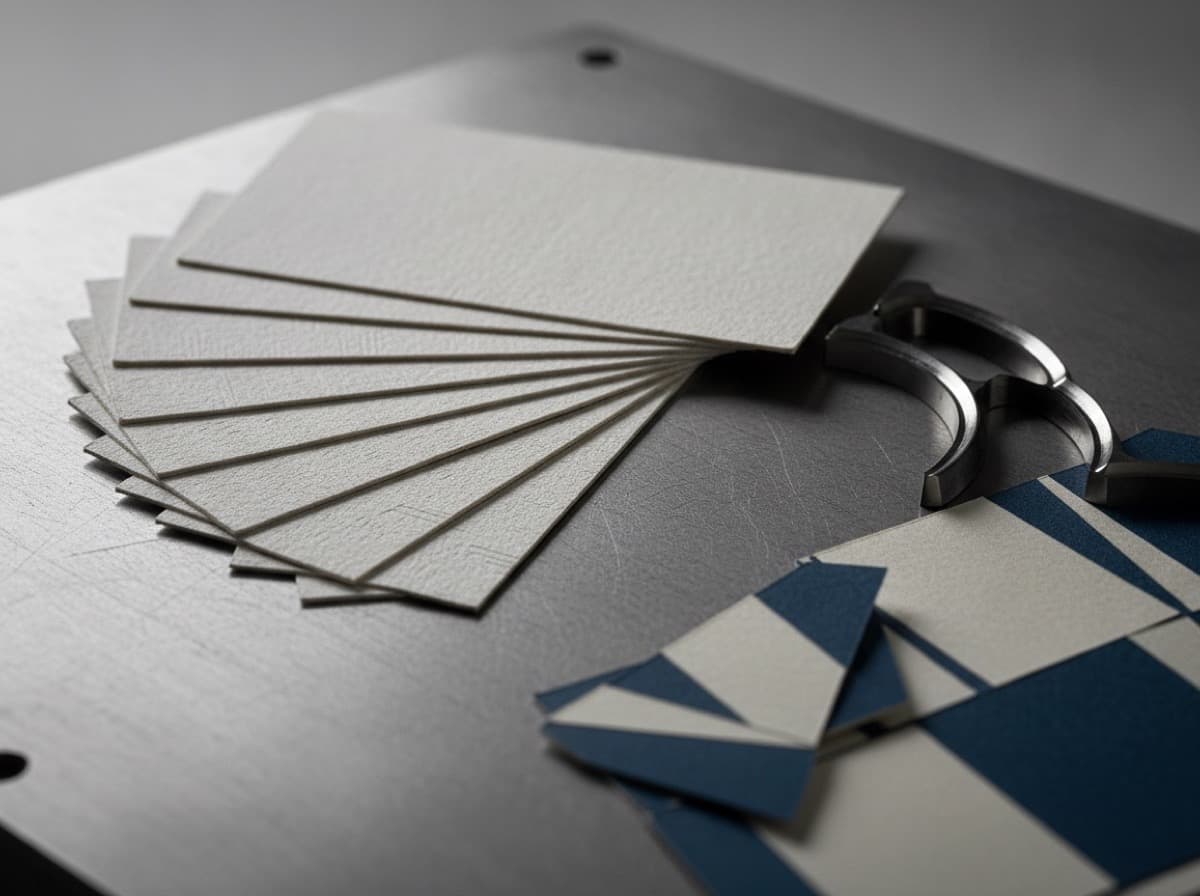
The business card format — 3.5 x 2 inches in North America, 85 x 55mm in Europe and most of the world — has been the standard for over a century because it fits in wallets and card holders. But the printing industry has developed a range of alternatives that make cards more memorable while remaining practical enough for real professional networking.
Standard Business Card Formats
3.5 x 2 inches (Standard US)
The North American standard business card size: 3.5 inches wide by 2 inches tall. This format is accepted by:
- All business card holders, organizers, and wallet slots
- Business card scanners
- Rolodexes and card files
- Most digital business card storage systems
When to use: Always the safe default when card wallet compatibility is essential. When in doubt, use the standard.
Note on orientation: Standard cards are almost always printed landscape (horizontal, 3.5" wide), but portrait (vertical, 2" wide by 3.5" tall) is also an option and increasingly popular for modern minimal designs.
3.5 x 2 inches Portrait Orientation
The same card size as standard, rotated 90 degrees to a tall vertical format.
Advantages: Distinctive from the horizontal majority of cards; works well with portrait photos, vertical logo treatments, and vertically-structured information layouts
Consideration: The portrait orientation still fits standard card holders, but may feel slightly unusual to recipients used to landscape cards. This is usually a benefit, not a drawback.
European Standard (85 x 55mm / 3.35 x 2.17 inches)
The ISO 7810 ID-1 standard, used in Europe, Asia, and most of the world outside North America. Slightly wider than the US standard.
When to use: For professionals who network primarily in European or international contexts where EU card dimensions are standard. Fits European card holders perfectly.
3.5 x 4 inches (Double Card / Folded Card)
A card that unfolds to reveal additional content. The closed size is 3.5 x 2 inches (standard); when opened, it reveals a 3.5 x 4 inch interior.
Best for:
- Professionals with significant content needs (services, specialties, map)
- Real estate agents (property listings or neighborhood map on interior)
- Consultants (full list of services)
- Healthcare providers (directions, insurance accepted, new patient information)
- Menu-style information display
Printing considerations: More expensive than flat cards; requires folding in the print production process; the spine of the fold needs to be printed carefully to avoid cracking on heavy stocks
Mini Cards (2.75 x 1.1 inches)
Smaller than standard; popularized by the MOO Mini format. Roughly 1/3 the area of a standard card.
Advantages: Distinctive and memorable; unique in a stack; can be printed with different images on the back of each card (variable data printing on back images)
Considerations: Does not fit standard business card holders; harder to read at a glance; information must be ruthlessly edited to fit
Best for: Creative professionals, photographers, artists, and those who want maximum differentiation; networking situations where physical card exchange is casual
Custom Shapes and Die-Cut Options
Square Business Cards (2 x 2 or 2.5 x 2.5 inches)
Square cards are the most popular non-standard format because they're distinctive without being impractical.
Advantages:
- Immediately distinctive; stands out in any stack
- Forces elegant, centered design choices
- Strong visual balance for logo-centric brands
- Still fits in shirt pockets and some card holders
- Popular in design, architecture, luxury goods, and creative industries
Common sizes:
- 2 x 2 inches — smaller square; compact and modern
- 2.5 x 2.5 inches — slightly larger; more room for information
- 55mm x 55mm — European square format
Design consideration: Square cards benefit from centered composition, bold logos, and minimal text. Busy designs can look cramped on a square format.
Round Cards and Circular Cards
Circular business cards are extremely distinctive but also the most challenging for recipients to store.
Advantages: Absolutely unforgettable; strong brand statement; creative industries, entertainment
Considerations: Does not fit any standard card holder; will stand out in a wallet but may annoy recipients who have organized card storage; for informal or high-impression networking events
Common size: 2.5 inch diameter circle
Round Corner Cards (Rounded Corner Cards)
Round corner cards maintain the standard 3.5 x 2 inch dimensions but with the four right-angle corners replaced by a smooth radius (typically 3mm or 5mm radius).
Advantages:
- More comfortable to hold and handle than sharp-corner cards
- Slightly softer, more approachable aesthetic
- Still fits all standard card holders and wallets
- Very small premium over standard sharp corners (usually $5–20 for a standard quantity)
- Appropriate for healthcare, wellness, counseling, education, and any profession emphasizing approachability
- Also appropriate for modern tech and startup brands
This is the easiest non-standard enhancement to add: Round corners cost little extra, fit everywhere the standard card fits, and create a noticeably more premium feel.
Slim Cards (3.5 x 1 inch)
Half the height of a standard card; a long, narrow format.
Best for: Cards designed to carry minimal information — a website, a name, a tagline. Used by designers, digital professionals, and minimal brands.
Consideration: Half as much information space; requires extremely editing; does not fit standard card holders
Die-Cut Custom Silhouette Cards
Die-cut cards use a custom die (a metal cutting tool shaped to the desired silhouette) to cut cards into any shape — not just rectangles, squares, and circles, but custom shapes that represent the profession, product, or brand.
Examples of profession-relevant die-cut shapes:
- House shape — real estate agents and mortgage brokers
- Key shape — real estate, property management, locksmith
- Car or vehicle silhouette — auto dealership, auto repair, car rental
- Guitar or musical note — musicians
- Camera shape — photographers and videographers
- Dog or paw print — veterinarians, pet groomers, dog trainers
- Wine glass or bottle — sommeliers, wine importers, restaurants
- Tree — landscapers, arborists, environmental professionals
- Briefcase — business consultants, attorneys, executives
- Stethoscope shape — healthcare professionals
- Wrench — plumbers, mechanics, HVAC contractors
Cost: Custom die-cutting adds significant cost: a new die may cost $100–$500 in addition to the printing cost; repeat orders using the same die are less expensive.
Practical consideration: Very custom shapes may have sharp narrow protrusions or structural weaknesses; dies need to be designed to create a card that holds together and can be held without tearing.
Thickness and Specialty Formats
Thick / Heavy Stock Cards
Standard business card paper is 14–16 pt thickness. Premium cards use:
- 24 pt thick cards — very noticeable weight; luxury premium feel
- 32 pt ultra-thick cards — substantial, impressive; noticeably heavy
- 36 pt double-thickness cards — two sheets laminated together; allows different colors or textures on front and back; exceptional quality statement
Combination formats: Heavy stock + matte laminate + spot UV creates the most tactilely impressive card format available
Metal Business Cards
Business cards cut from thin aluminum, brass, copper, or stainless steel.
Advantages: Absolute maximum impression; people keep them forever; excellent for luxury real estate, high-end finance, exclusive membership clubs
Considerations: Very expensive ($1–$5+ per card depending on material and design); heavy; some venues (airport security) may require explanation; not everyone appreciates them
Wooden Business Cards
Cards cut from thin wood veneer (usually birch or bamboo).
Advantages: Eco-friendly signal; tactile warmth; excellent for woodworkers, builders, environmental brands, wellness
Considerations: Wood grain means every card is slightly different; laser engraving rather than printing; durable but natural material has natural variation
Clear/Transparent Cards
Cards printed on clear or frosted PVC (polycarbonate plastic).
Advantages: Very distinctive; a window effect where transparent portions reveal what's behind the card; technology, design, luxury, entertainment industries
Considerations: Significantly more expensive than paper cards; limited to CMYK printing on clear substrate; some recipients find them feel fragile
Choosing Your Card Format
| Professional Context | Recommended Format | |---------------------|-------------------| | Conservative professions (law, finance, medicine) | Standard 3.5 x 2 or portrait with round corners | | Creative and design professionals | Square, portrait, or heavy stock with specialty finishes | | Real estate agents | Standard with key die-cut or standard landscape | | Healthcare and wellness | Round corners; warm colors; standard or portrait | | Networking events (informal, creative) | Mini cards or square | | International business | European 85mm x 55mm or standard US | | Luxury and high-end | Ultra-thick, metal, or heavy stock + foil | | Tech startups | Square or standard with bold digital aesthetic | | Contractors and trades | Standard landscape with practical service information | | Artists and musicians | Mini, square, or custom die-cut shape |
Production Notes for Non-Standard Cards
Lead time: Custom die-cut and unusual formats require longer production time than standard cards; plan 5–10 extra business days
Proofing: Always request a physical proof before a large run of non-standard shapes; die-cutting can shift slightly and needs verification
Quantity minimums: Custom die-cuts often have higher minimum quantities (250–500+) than standard cards
Card storage: Consider how recipients will store your card; a card that doesn't fit in standard card holders may be memorable but also quickly misplaced or discarded
Get 10% off your first order
Join our list for practical printing guides, new finish ideas, and a welcome coupon for your first order.
No spam. Unsubscribe anytime.
Ready to put these tips into print?
Order Business CardsNot sure which option fits? Ask Pro Card Crafters