Letterpress Business Cards: The Premium Printing Process That Creates Unforgettable Cards
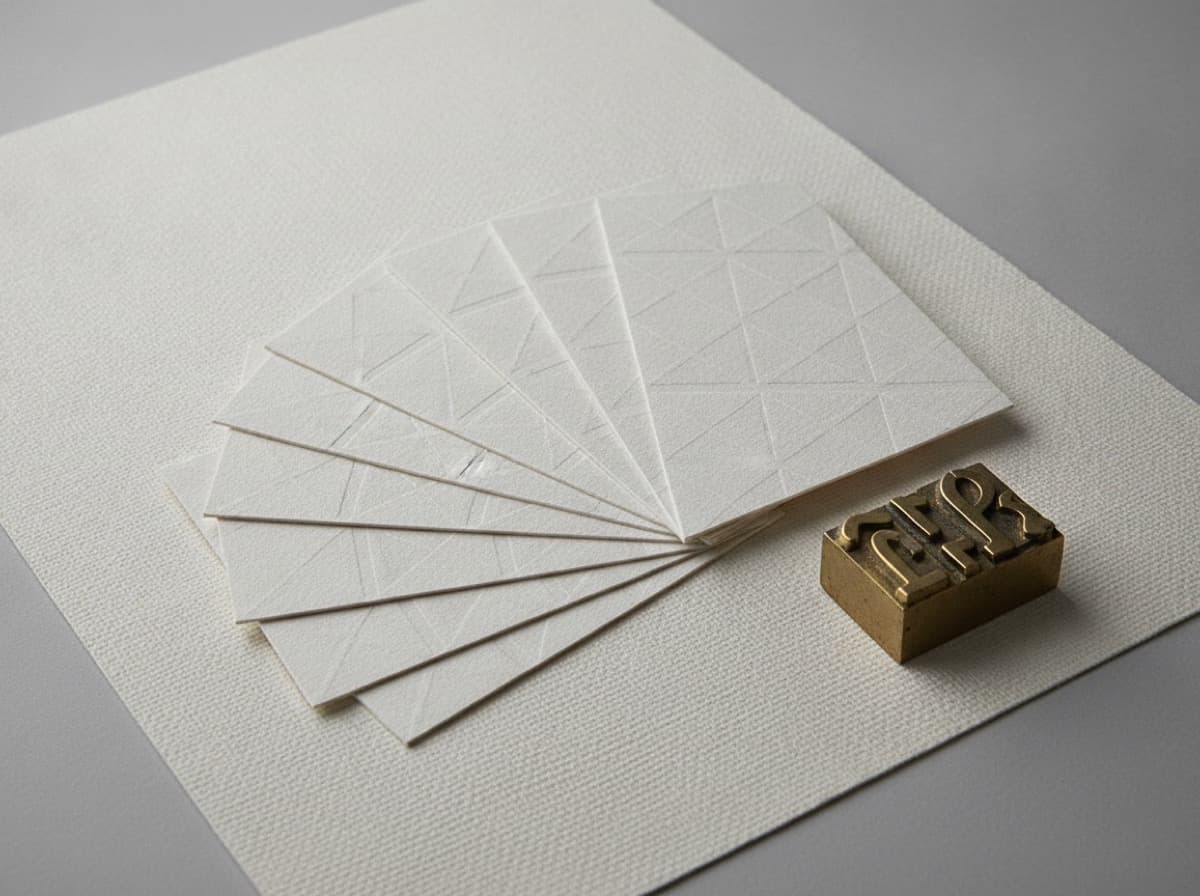
Letterpress is the oldest commercial printing process still in use — and for business cards, it produces results that no modern digital printing method can match. The process physically impresses type and design elements into thick cotton paper, creating an indented relief that's visible to the eye and tangible to the touch.
A letterpress business card doesn't just look good. It feels definitively different from everything else in a wallet.
How Letterpress Printing Works
In letterpress printing, a raised plate (historically made of movable metal type — today, typically a photopolymer plate) is inked and then pressed into the paper under significant pressure. The impression creates an indented area in the paper itself — the distinctive "kiss" or "deep impression" that defines letterpress.
The printing sequence for a typical letterpress card:
- Design is converted to a photopolymer plate (one plate per ink color)
- Paper is fed through the press
- The plate, loaded with ink, presses into the paper
- For multiple colors, the card passes through the press multiple times
- For additional finishes (edge painting, foil), those steps follow
What makes letterpress different:
- The impression depth is visible and tactile — you can see and feel where the type was pressed
- Cotton/rag paper has a texture, weight, and warmth that coated commercial stock doesn't
- Colors are deeply saturated and physically embedded in the paper
- The overall effect is impossible to scan, photograph, or digitally replicate convincingly
The Paper
Letterpress is almost always printed on cotton or rag paper — 100% cotton fiber (sometimes called "cotton rag" or "bamboo") rather than wood-pulp paper. Cotton paper:
- Accepts impression deeper and more cleanly than wood-pulp paper
- Is significantly thicker — typically 110-220lb cover weight (much heavier than standard 80-100lb)
- Has a natural texture that photographs and feels premium
- Ages beautifully without yellowing
Common letterpress paper options:
- Crane's Lettra: The most widely used letterpress paper. 100% cotton, available in Fluorescent White and Pearl White, 110lb and 220lb (double-thick)
- Reich Savoy: Cotton-content luxury paper with a slightly different texture
- Cotton card stock from other mills: Various suppliers produce quality cotton stock for letterpress
Paper thickness:
- 220lb Lettra (the most popular) is approximately 0.85mm thick — substantially thicker than a standard business card
- Some letterpress printers offer 2-ply or even 3-ply mounting (gluing two or three sheets together for exceptional thickness)
Design for Letterpress
Letterpress-Appropriate Design
Not all designs translate well to letterpress. The process has specific strengths and limitations that should guide design decisions.
What letterpress does beautifully:
- Clean serif and sans-serif typography with defined edges
- Simple geometric shapes and lines
- Logos with clean vector geometry
- Monogram and initial cards
- Minimal, refined compositions
What letterpress struggles with:
- Very thin hairlines (under 0.25pt — may not hold ink reliably)
- Gradients (letterpress prints flat ink, not gradients)
- Fine photographic detail (half-tones are possible but limited)
- Very small type below 7pt (may fill in or lose legibility)
- Extremely complex detailed illustrations (lose detail in impression)
The design philosophy: Letterpress rewards restraint. A card with one beautifully set word in a single ink color, impressed deeply into thick white cotton, is more powerful than a complex full-color design. Design for the process, not against it.
Color Limitations
Traditional letterpress is often 1 or 2 colors — each color requires a separate plate and press pass. Color limitations lead to design discipline:
- 1 color: Maximum restraint. Often the most striking cards — black on white, navy on cream, or deep red on ivory.
- 2 colors: Allows a second design element or accent
- 3+ colors: Possible but increases cost significantly (each color = one press pass)
- No color (blind impression): The plate presses into the paper without ink, creating a debossed relief in the paper itself. Subtle but extremely tactile.
Pantone color matching: Letterpress inks are mixed to order, typically to Pantone specifications. You can match a precise brand color more reliably than in offset or digital printing.
Setting Up Your File
Letterpress files are typically delivered as:
- Adobe Illustrator .ai or PDF: Vector artwork, with each color on a separate layer
- Separate files per color: Some printers prefer separate files for each ink color
File specifications:
- All fonts converted to outlines (no live type)
- All elements vectorized (no embedded raster images)
- Each color on a clearly labeled separate layer
- Art at final size (no scaling needed)
- Minimum stroke weight: 0.25pt (prefer 0.5pt for reliability)
- Minimum text size: 7pt (prefer 8-9pt for reliability)
- Color specified as Pantone codes
Registration consideration: Each pass through the press may shift slightly. If your design has two colors that meet precisely, build 0.5pt of overlap where they share an edge (one color overlapping the other slightly) to avoid white gaps between colors from registration variance.
When to Use Letterpress
Letterpress is the right choice when:
1. Your card's quality needs to signal something important Attorneys, luxury real estate agents, architects, designers, and others who sell high-trust or high-value services benefit from a card that itself communicates investment and quality. The card cost is a small fraction of what a single client relationship is worth.
2. You're in a creative or design field Letterpress demonstrates aesthetic judgment. In the design industry specifically, the card is evaluated as a design object. A letterpress card signals that you appreciate craft.
3. You need to stand out in a context where most cards are generic A letterpress card in a stack of offset cards is immediately distinctive — different to touch, different to look at, impossible to forget.
4. You're making a smaller quantity Letterpress's per-card cost is higher than offset or digital printing, but the setup cost (plate making) is fixed. For 100-500 cards, the per-card cost premium is more manageable.
Cost Range
Letterpress is significantly more expensive than standard printing:
| Quantity | Approximate Cost Range | |---|---| | 50 cards | $120-200 (high per-card cost; minimum quantities often apply) | | 100 cards | $150-300 | | 250 cards | $200-450 | | 500 cards | $300-650 | | 1,000 cards | $450-900 |
Prices vary significantly based on:
- Number of ink colors (each color adds a press pass)
- Paper choice (220lb vs. 110lb, cotton vs. standard)
- Impressional depth preference
- Edge painting or additional treatments
- Printer location and setup
Reputable letterpress printers:
- Letterpress shops typically require 250+ minimum quantities
- Turnaround: 3-5 weeks is typical (shorter rush at premium)
- Online letterpress printers exist but quality varies — see physical samples before ordering
Letterpress + Other Finishes
Letterpress + edge painting: Edges of the thick cotton card stack are painted with a solid color (red, gold, navy, etc.). Visible when cards are held in a stack or at an angle. Adds another layer of distinctive premium.
Letterpress + foil: Letterpress for the main text; foil stamping for the name or logo. The two processes are compatible and complementary.
Letterpress + envelope: Invitations to events, holiday cards, or custom letterpress card sets can include custom envelopes — particularly relevant for social and wedding stationery adjacent to business card use.
Checklist
- [ ] Design uses maximum 2-3 colors (simpler = stronger in letterpress)
- [ ] All strokes minimum 0.25pt (prefer 0.5pt+)
- [ ] No gradients or rasterized effects
- [ ] Text minimum 7pt (prefer 8pt+)
- [ ] Each color on a separate layer, labeled
- [ ] Colors specified as Pantone codes
- [ ] Paper selection made (220lb Lettra or equivalent)
- [ ] Printer samples reviewed before ordering
- [ ] Registration overlap built in where colors adjoin
- [ ] Budget confirmed for quantity (typically $0.60-2.00 per card)
- [ ] 3-5 week lead time built into schedule
Get 10% off your first order
Join our list for practical printing guides, new finish ideas, and a welcome coupon for your first order.
No spam. Unsubscribe anytime.
Ready to put these tips into print?
Order Business CardsNot sure which option fits? Ask Pro Card Crafters