Standard Business Card Sizes: US, European, Square, and Mini Card Dimensions
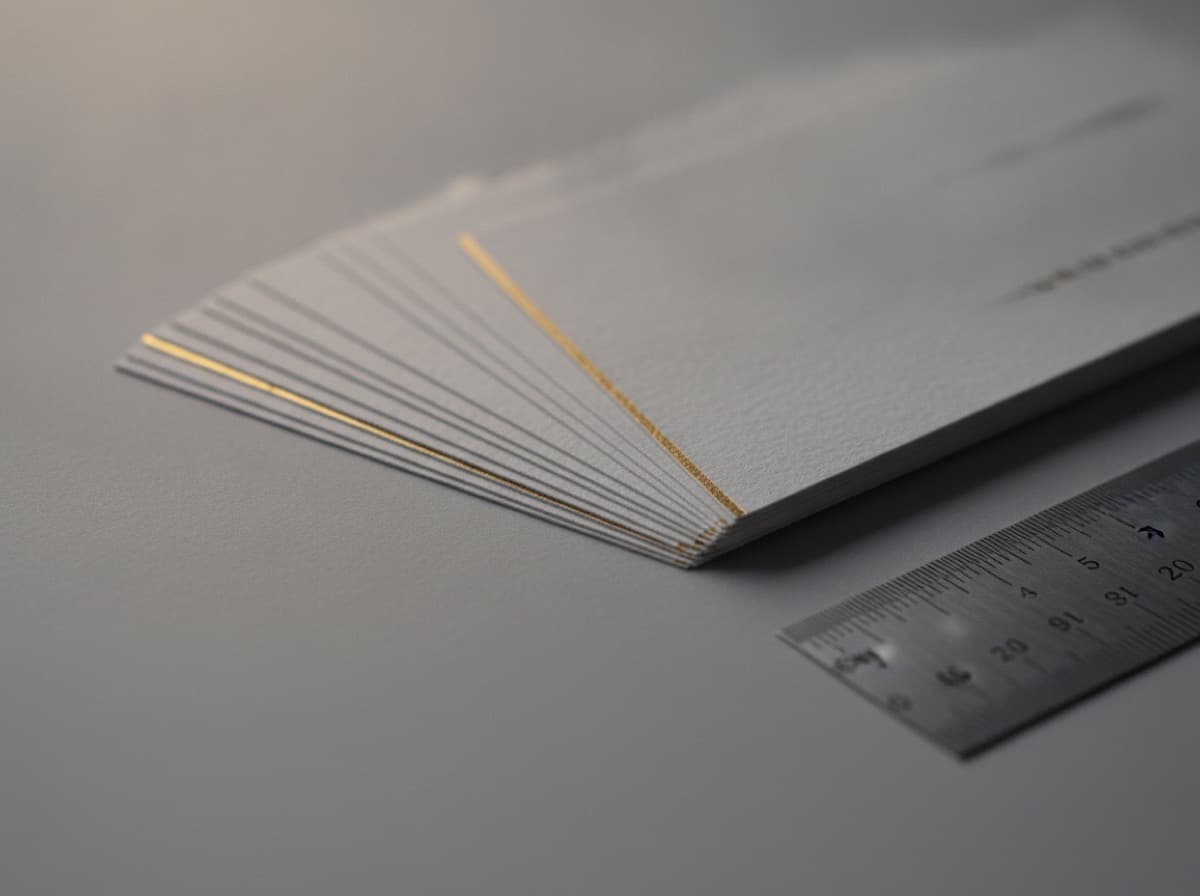
The dimensions of a business card are not arbitrary — they're standardized to fit wallets, card holders, Rolodex slots, and business card scanners. But "standard" varies by country, and there's a growing market for non-standard sizes (square, mini, and vertical cards) that can differentiate a card when used intentionally. This guide covers every major business card size and the design considerations specific to each.
US Standard Business Card: 3.5" × 2" (88.9 × 50.8mm)
The most common business card size in North America. Fits standard US business card holders, wallets, and most card storage systems.
Print-ready dimensions (with bleed): 3.625" × 2.125" (91.9 × 54mm)
How to use these dimensions:
- The 3.625" × 2.125" file size includes 1/8" bleed on all four sides
- Keep all critical content (text, logo, important design elements) inside the 3.25" × 1.75" "safe zone" — 1/8" inside the cut line on all sides
- The safe zone protects content from being trimmed during cutting
Orientation options:
- Landscape (horizontal): The traditional orientation; name and contact on the long axis; most familiar
- Portrait (vertical): Name running top-to-bottom; distinctive, associated with creative and East Asian businesses; increasingly popular in design circles
When it's the right choice:
- For any North American business or professional
- Whenever the card needs to fit in a standard US card holder or business card portfolio
- When wallets, Rolodex systems, or scanners matter
European Standard (Credit Card / CR80): 85.6 × 54mm (3.37" × 2.13")
The standard used in most of Europe, Australia, and parts of Asia. Slightly narrower than the US standard. This is also the exact size of a credit card.
Print-ready dimensions (with bleed): 86.6 × 55mm (adding 0.5mm bleed on each side)
Compared to US standard:
- 3.2mm (1/8") narrower
- Nearly the same height
- Fits most standard international business card holders
When it's the right choice:
- For international businesses with European or Australian client bases
- For any business where cards will primarily circulate in Europe
- When credit-card-sized cards (same physical dimensions as a credit card) are preferred
Square Business Cards: 2.5" × 2.5" (63.5 × 63.5mm)
Square cards break from the rectangular norm and create an immediate differentiation. They're more visually distinctive in a stack and demand more creative design.
Print-ready dimensions (with bleed): 2.625" × 2.625" (66.7 × 66.7mm)
Design considerations for square cards:
- The square format naturally centers the design — symmetry tends to look intentional on square cards
- Logo and name in the center, contact details distributed symmetrically or in a grid
- The format suggests confidence and modernity
- Central design works better than landscape alignment
Fitting challenges:
- Square cards do NOT fit in most business card holders (designed for rectangular cards)
- They fit in wallets but take more space
- Standard card pages/books (Rolodex inserts) don't accommodate square cards
When it's the right choice:
- When you want the card itself to be memorable (creative professionals, designers, boutique brands)
- When clients are more likely to put the card on a desk than in a cardholder
- When the square format reinforces the brand (square logo, square brand identity, social-first brand where square is the native format)
Mini Business Cards / Slim Cards: 3.5" × 1.75" or 3.5" × 1" (88.9 × 44mm / 88.9 × 25.4mm)
Mini cards are narrow cards — the same width as a standard business card but noticeably shorter in height. The most popular mini format is 3.5" × 1.75" (half the height of standard), sometimes called "slim" or "half" cards.
Design considerations:
- The reduced vertical space forces extreme simplicity — name, title, and one or two contact methods only
- The slim format is inherently modern and editorial
- Mini cards often serve as loyalty punch cards, appointment reminder cards, or category-specific specialty cards (a nail technician handing a "loyalty punch card" that doubles as a contact card)
When it's the right choice:
- When you want to include both a mini card (quick contact) and a larger card (full information)
- For cards that serve a secondary function (loyalty, appointment, promo)
- When simplicity and minimalism are the brand identity
Folded Business Cards: 3.5" × 4" folds to 3.5" × 2"
A folded card is the standard business card size when closed, but opens to reveal 4 panels (2 on each side) — effectively tripling the information space of a standard card.
When it's the right choice:
- When you genuinely have more information than a standard card can hold
- For photographers, artists, or professionals who want a mini portfolio inside
- For healthcare professionals listing extensive credentials and services
Design note: Folded cards require extremely careful design around the fold line — never place critical text on the fold.
Vertical Business Cards: 2" × 3.5" (standard card, portrait orientation)
A vertical card is the same dimensions as a standard US business card (3.5" × 2") printed in portrait orientation. The "size" is the same; only the orientation changes.
Design considerations:
- Vertical orientation naturally flows name at top, contact details below
- Works particularly well for professionals whose name is the primary brand (solo practitioners, personal brands)
- Requires rethinking the information hierarchy — vertical reading versus horizontal reading differs
When it's the right choice:
- Creative and design professionals (vertical is associated with editorial/magazine aesthetic)
- Personal brands (life coaches, speakers, authors)
- Businesses with visual content better suited to vertical display (portrait photography, food photography)
Choosing Your Card Size
For most North American businesses: US standard 3.5" × 2", landscape orientation
For creative or design-adjacent businesses: Square (2.5" × 2.5") or US standard vertical
For international business travel: European CR80 (85.6 × 54mm) if primarily European clients, or carry two card types
For maximum information density: Folded card
For minimalist branding: Mini/slim card (3.5" × 1.75")
File Preparation by Size
| Size | Finished | With Bleed (1/8" each side) | |------|----------|---------------------------| | US Standard | 3.5" × 2" | 3.625" × 2.125" | | European | 85.6 × 54mm | 88.6 × 57mm | | Square | 2.5" × 2.5" | 2.625" × 2.625" | | Mini (slim) | 3.5" × 1.75" | 3.625" × 1.875" | | Folded (open) | 3.5" × 4" | 3.625" × 4.125" |
Always design to the bleed dimensions; the cutting margin removes the bleed; critical content must stay inside the safe zone (1/8" inside the cut line on each side).
Get 10% off your first order
Join our list for practical printing guides, new finish ideas, and a welcome coupon for your first order.
No spam. Unsubscribe anytime.
Ready to put these tips into print?
Order Business CardsNot sure which option fits? Ask Pro Card Crafters