Are Business Cards Still Relevant in a Digital Age?
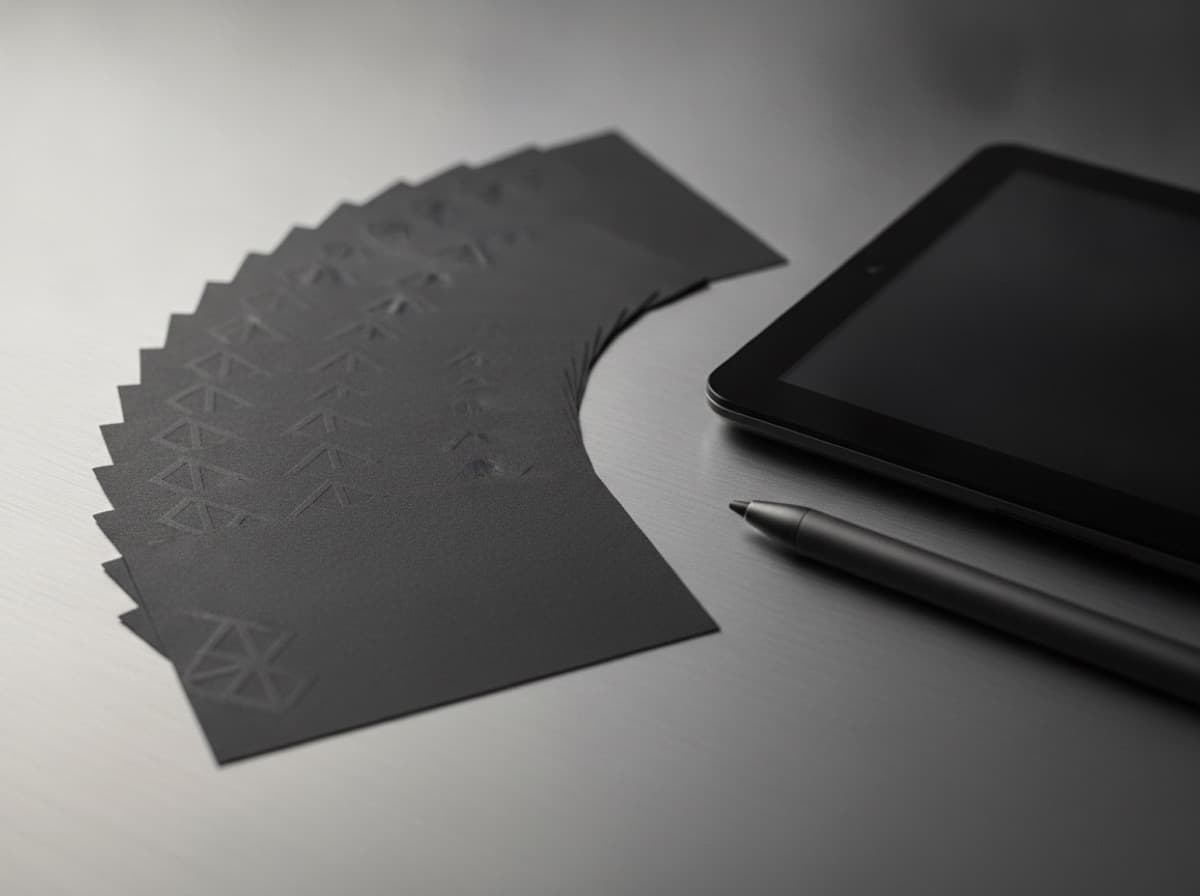
Business cards are still relevant in 2024 — not because digital alternatives have failed, but because the physical card does something that exchanging contact information digitally cannot: it completes the moment of connection with a tangible artifact that the recipient holds, keeps, and returns to. The question isn't whether business cards compete with smartphones for information transfer; they don't, and they shouldn't. The question is whether the physical ritual of handing and receiving a card adds something to a professional interaction that no digital exchange replicates. For a significant number of professional contexts — and nearly all premium ones — the answer is yes.
What business cards do that digital exchange can't
They force intent. Reaching into a pocket, handing something over, and receiving it with two hands (in many cultures) is a deliberate physical act. It signals that you are worth the effort of the ritual. Bumping phones or scanning a QR code from a screen is information transfer; the card exchange is closer to a handshake in meaning.
They persist in physical space. A business card placed on a desk or tucked into a notebook is a persistent physical reminder of a person and a conversation. A contact added to a smartphone is one of hundreds or thousands in a contacts list, findable only if the person remembers the name. The card creates a different kind of memory trace.
They carry brand signals that screens don't. The weight of a letterpress cotton card, the tactile quality of a soft-touch laminate, the surprise of a foil-stamped logo — these are first impressions that digital equivalents cannot produce. When the card itself is an expression of the work you do, it precedes your portfolio.
They work everywhere. No connectivity, no dead battery, no cross-platform compatibility issue. A card works in a basement conference room with no signal, in an international airport, at a client's dinner table. For global business, the business card's universality remains a practical advantage.
Where business cards matter most
Cards are most valuable in contexts where the relationship is initiated in person and where a lasting first impression is the goal:
- Professional services — consultants, attorneys, accountants, architects, and financial advisors who build client relationships over years
- Creative industries — designers, photographers, art directors, architects, and makers whose card is a sample of their sensibility
- Sales and business development — where a meeting is an investment and the card is a follow-up vehicle
- Conferences and industry events — where high-volume networking happens and cards are still the common currency of exchange
- International business — particularly in Japan, South Korea, and China, where card exchange protocols are deeply embedded in business culture
Where business cards matter less
Digital alternatives make more sense when:
- All professional interaction is screen-mediated (fully remote work)
- The contact's next action is entirely digital (scanning a QR code to subscribe)
- Volume matters more than quality of impression (high-turnover retail, job fairs where brand impression is secondary)
- The audience skews strongly millennial or younger and the professional context is informal tech
But even in these settings, a well-designed card still performs better at high-stakes in-person interactions. Most people who claim they don't need cards haven't received a great one.
Do QR-code-only cards replace traditional cards?
QR-code digital business cards (NFC-enabled cards, cards with only a QR code leading to a digital profile) are a real category and serve a purpose. They're useful when the goal is purely information transfer and the follow-up relationship is entirely digital. They're a poor substitute when the physical artifact is itself the brand signal.
The people who most benefit from digital card replacements are also those who would benefit most from a premium physical card that includes a QR code — the two aren't mutually exclusive. A card with a QR code on the back bridges both: the card serves the high-touch moment, the code serves the digital follow-up.
The case for upgrading rather than eliminating
The conversation about whether cards are still relevant often happens at the same time as the revelation that the speaker is carrying 14pt gloss cards from an online commodity printer — the kind that looks like a template, feels like a Post-it, and contributes nothing to any impression. That card probably isn't relevant anymore, because it says nothing and provides only the information that could be sent in a text.
A card that represents genuine investment in design and finish — foil, letterpress, edge painting, or just a clean design on great stock — is still one of the most cost-effective brand impressions in professional life. A set of 250 premium cards costs less than a single dinner and creates a first impression every time one is handed over.
Bottom line
Business cards are still relevant when physical professional interaction is part of the job and brand impression matters at the moment of introduction. They're most relevant when the card itself carries brand signals — quality stock, thoughtful design, a premium finish — that digital exchange cannot replicate. They're less relevant when all professional interaction is already digital. For most professionals who work in person at any meaningful frequency, a well-made card remains worth having.
Frequently Asked Questions
Are business cards still relevant in the digital age?
Yes, for most professionals who work in person. The physical card exchange does something a digital contact share can't: it creates a deliberate, tangible artifact of a connection. In professional services, creative industries, and any context where brand impression matters at first meeting, a quality card still delivers value that digital alternatives don't replicate.
Do young professionals still use business cards?
Yes, particularly in industries where in-person networking is standard — finance, law, design, consulting, sales, hospitality, and events. The format has declined in purely digital-first contexts, but it remains common in most traditional professional environments.
What is a digital business card and should I use one instead?
A digital business card uses an NFC chip or QR code to transfer contact information digitally. It's useful for purely digital follow-up contexts but doesn't replicate the physical experience of a card exchange. The two aren't mutually exclusive — a physical card with a QR code on the back bridges both.
Do business cards still help with networking?
Yes. A business card is the final step of an in-person introduction — it closes the exchange and gives the other person something to return to. For professional networking at events, conferences, and client meetings, they remain effective.
Is it worth getting premium business cards instead of cheap ones?
For most professionals, yes. A premium card — good stock, quality finish, clean design — signals competence and care. A commodity card signals that you treat the interaction as a transaction. The cost difference per card is small; the impression difference is significant.
What industries still use business cards the most?
Professional services (law, finance, consulting, accounting), creative industries (design, photography, architecture), sales and business development, healthcare, and hospitality. Internationally, Japan, South Korea, and China have particularly strong business card cultures with formal exchange protocols.
Get 10% off your first order
Join our list for practical printing guides, new finish ideas, and a welcome coupon for your first order.
No spam. Unsubscribe anytime.
Ready to print what your business needs?
Browse Printing ProductsNot sure which option fits? Ask Pro Card Crafters